


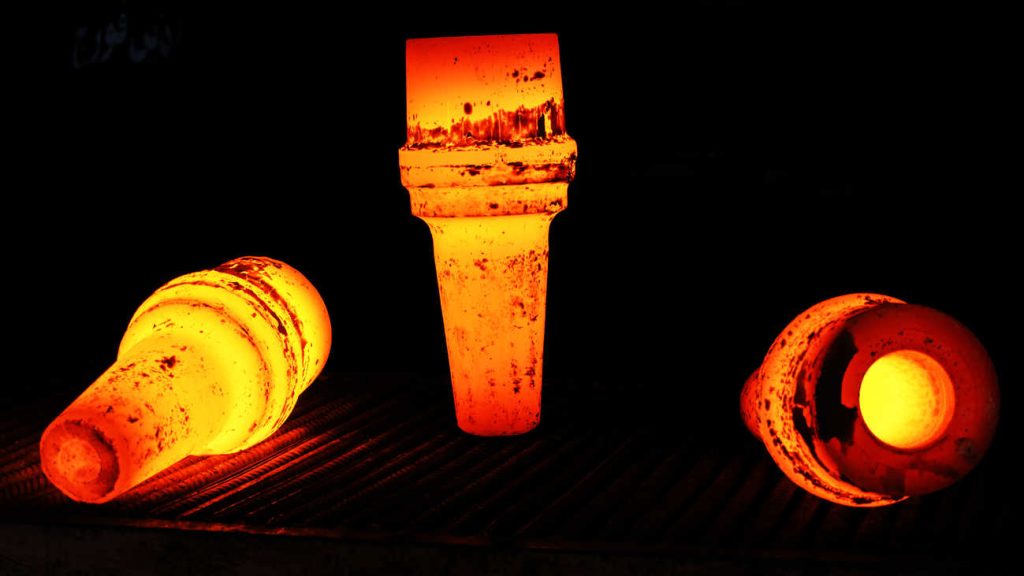
In the forging process, metal is compressed between two dies under extremely high pressure to form the final shape of the part. However, the type of die — open or closed — directly affects the accuracy, quality, cost, and application of the product. This article explains the difference between open‑die and closed‑die forging in a clear, engineering‑based way to help manufacturers choose the right production method.
Open‑die vs. closed‑die forging dies
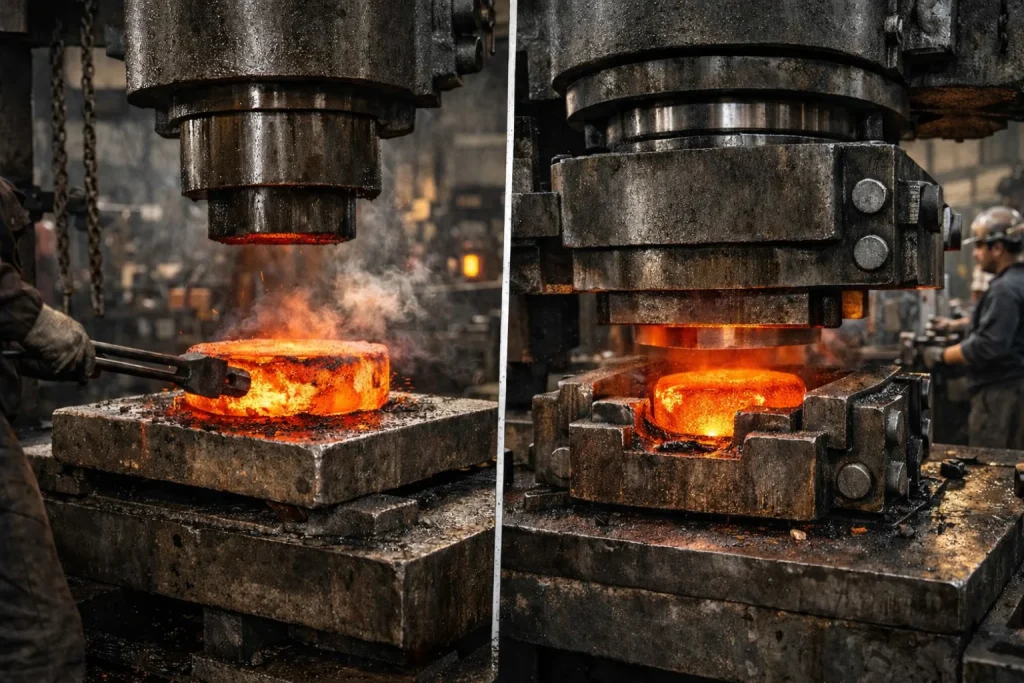
Open‑Die Forging
In this method, the metal is placed between flat or semi‑flat surfaces, and the final shape is formed approximately.
Characteristics
- The die lacks a precise cavity
- The metal deforms freely during hammering
- Suitable for large, heavy, and simple parts
- Commonly used in oil & gas, heavy machinery, shafts, and discs
Advantages
- Low die manufacturing cost
- Ideal for large‑scale parts
- Shape can be adjusted during the process
- High flexibility in production
Disadvantages
Lower dimensional accuracy
Requires extensive final machining
Not suitable for mass production

Closed‑Die Forging
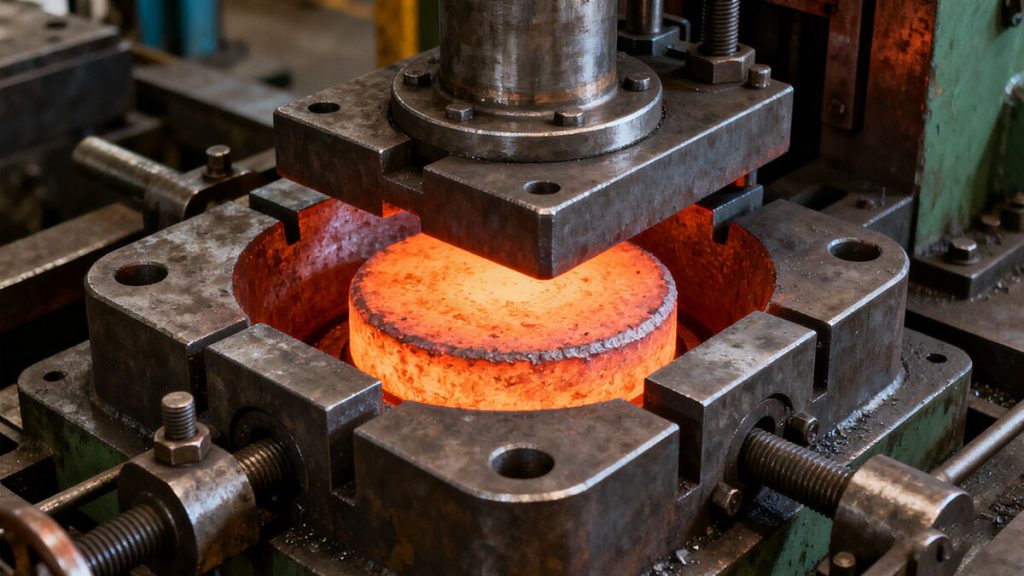
In this method, the metal is placed inside a precisely shaped cavity and completely takes the form of the die.
Characteristics
- The die has a detailed, engineered cavity
- The metal is fully enclosed during forging
- Suitable for small, complex, and precise parts
- Commonly used in automotive, industrial equipment, mechanical fittings, and gears
Advantages
- Very high dimensional accuracy
- Better surface finish
- Ideal for mass production
- Reduced need for machining
Disadvantages
Higher die manufacturing cost
Requires precise design and heat treatment
Limited for very large parts
Quick Comparison: Open‑Die vs. Closed‑Die Forging
| Feature | Open‑Die Forging | Closed‑Die Forging |
|---|---|---|
| Dimensional Accuracy | Low | Very High |
| Die Cost | Low | High |
| Application | Large, simple parts | Small, complex parts |
| Machining Requirement | High | Low |
| Ideal for mass production | No | Yes |
Conclusion
Choosing between open‑die and closed‑die forging depends entirely on the type of part, production volume, and required precision. For large, heavy, and simple components, open‑die forging is the best choice. For precise, complex, and mass‑produced parts, closed‑die forging is the ideal solution.
This understanding helps Russian companies make informed decisions when ordering molds, ensuring they select the right type for their production needs.